what was the “iron curtain†that winston churchill referred to?
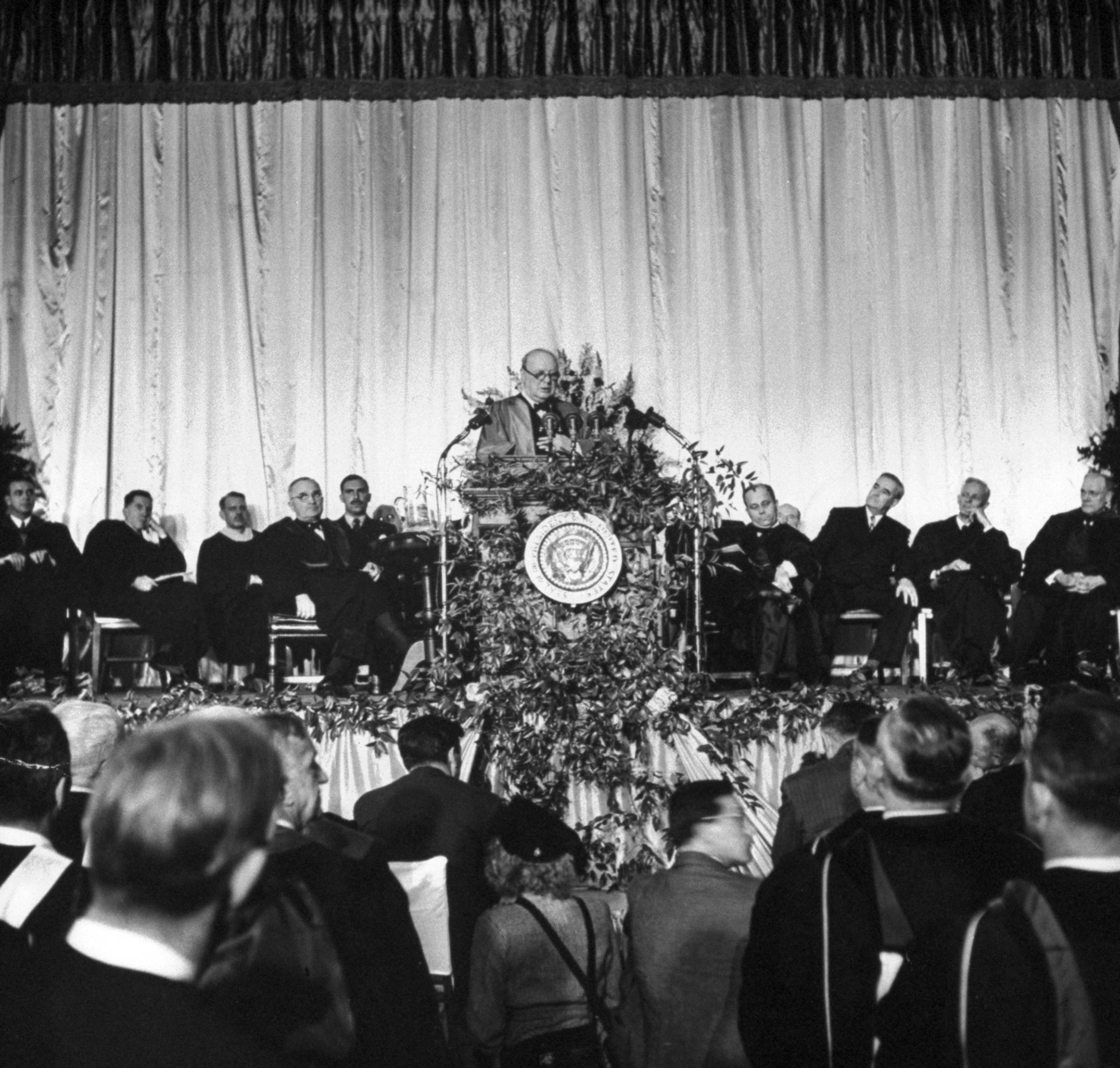
Fri five March marks the 75th anniversary of Winston Churchill's one and merely visit to Fulton, Missouri. On the campus of Westminster College, the former prime number minister delivered what became known as his "Iron Mantle" speech. With the US President Harry Due south Truman sitting beside him and the Soviet leader Josef Stalin firing back a blistering diatribe from Moscow, Churchill'south address at Fulton is now seen as a landmark moment in the ideological polarisation of the early on Common cold State of war. It is also i of his about celebrated speeches, on a par with those he made in the summertime of 1940.
For both these reasons, the anniversary should not laissez passer without comment. Yet there is a larger consequence at stake. Churchill's reputation has eventually been caught in the inevitable whirligig of time, equally politicians lauded in their own generation after become targets of criticism and even abuse. This has been peculiarly credible in the past year, as the Black Lives Affair movement shifted the spotlight from the champion of freedom against Nazism to the ardent defender of Britain's empire. Views of Churchill have become increasingly polarised – the Hero of the Right and the Villain of the Left – with each side often displaying a cardboard cut-out figure.
What we need is a more rounded, three-dimensional picture of 1 of the most meaning leaders of the 20th century – an understanding of Churchill as a complex human existence, rather than either icon or demon. His Fulton speech of March 1946 is a good place to start, because it involved far more than the famous tagline almost an atomic number 26 drape coming down across postwar Europe. In fact, "Iron Drape" was never Churchill's own title. He called his speech "The Sinews of Peace".
Similar so much of Churchill's life, his trip to Fulton was a story of principled cocky-promotion – a considered response to the breakdown of the wartime alliance delivered as part of his fightback from electoral defeat in the July 1945 ballot. That Labour landslide marked the worst Tory operation since 1906, which had brought Churchill – a Tory turned Liberal earlier re-ratting again in the 1920s – his first taste of governmental office. In 1945 the Bourgeois Party made Churchill the centrepiece of its election entrada – "Assistance HIM end the Job" – and then the humiliation felt very personal. Clementine Churchill was conscious that her husband was wearied after five gruelling years equally war leader. "It may well be a blessing in disguise," she remarked consolingly. "At the moment," he grunted, "it seems quite effectively disguised."
Fortunately for Churchill, Field Marshal Sir Harold Alexander, the British commander in Italy, made available his official villa on Lake Como. At that place Winston threw himself into painting, a pastime he had put aside during the war. On 8 September he told his doctor, Lord Moran: "With my painting I have recovered my balance." He wrote home to Clemmie, "I feel a swell sense of relief, which grows steadily, others having to face the hideous issues of the aftermath." And, he admitted: "Information technology may well indeed be 'a blessing in disguise'."
But Como could only exist a temporary respite. Moran likened the loss of political ability to the shock of major surgery. Other ex-leaders used the same metaphor: when Konrad Adenauer, the veteran Westward German Chancellor, was finally evicted from office in 1963 by his colleagues, at the historic period of 87, he said it felt like having his arms and legs cut off. Although Churchill was only 70 in the fall of 1945, the vultures seemed to be gathering. Tories talked of the demand for a fresh face and there was a whispering entrada in the press that Winston would presently hand over to his heir-apparent, Anthony Eden.
Content from our partners



In that location were times in late 1945 when Churchill did indeed come up close to bowing out of politics. He had no energy for routine party affairs, and left much of Commons business to Eden. On 15 December he told the Knuckles of Windsor, whose cause he had quixotically championed during the abdication crisis of 1936, "The difficulties of leading the opposition are very great and I increasingly wonder whether the game is worth the candle." Yet what else was there to practice? He had no ambition for a big book project. His A History of the English-Speaking Peoples, put aside in 1940, languished in the files, and he lacked the mental or physical energy to embark on his memoirs of the recent state of war. He all the same craved ability, and the sense of meaning that came with it – the ability to shape corking events which had galvanised him all his life. During a low in the election campaign, he told his doctor sadly, "I accept no message for them now." The man who had given the king of beasts's roar in 1940 felt he had nil to say to his country, or the world.
His postbag, of course, bulged with requests to give speeches all over the world. But most of them elicited a polite "no" from his secretaries. An invitation to deliver the annual John Findlay Green Foundation Lectures at an obscure higher in America's rural hinterland (worse however, a dry campus) would have received similar treatment, but for a PS scrawled at the bottom: "This is a wonderful school in my home state. Hope you tin can do information technology. I'll introduce you. Best regards – Harry South Truman." Churchill told the president that he was planning a wintertime of "rest and recuperation" in Florida and could non contemplate delivering four lectures. Nevertheless, responding to the postscript, he told Truman: "I should feel it my duty – and it would also be a bang-up pleasure – to deliver an Address to the Westminster University [sic] on the world situation, nether your aegis."
As Churchill made clear, the attraction of Fulton lay non in the tiny college town itself (population 8,000, boilerplate annual student grade 350) but in the prospect of the United states of america president beingness on the podium beside him. This would guarantee him a worldwide audience. In true Churchillian style he devoted an immense amount of time to the content and phrasing of his text, revising it with his secretary on the train until the concluding minute. And, like many of his speeches, the statement was more than complex than the stereotypical view of Churchill the flamboyant orator suggests.
***
The spoken communication had 4 themes. First, and about familiar, was his statement that "from Stettin in the Baltic to Trieste in the Adriatic, an fe curtain has descended beyond the continent". East of that line, in "the Soviet sphere", said Churchill, people were bailiwick to "a very high and, in many cases, increasing mensurate of Soviet command". The phrase "iron curtain" – as Churchill himself recalled – dated back to burn down-rubber devices in the Victorian theatres of his youth. It had been transposed to Russia and the West after the Bolshevik Revolution and then applied to the Red Ground forces'south advance across Europe past Josef Goebbels, from whom Churchill probably picked it up in May 1945. Similar a vino taster, notwithstanding, he had been swilling similar words around in his rima oris for months – with "veil" or "screen" as culling nouns – before using "atomic number 26 curtain" publicly in the Commons on 16 August 1945. Simply it was Churchill's commanding performance for the president that gave the phrase global currency, conveying a stark, if simplified, paradigm of postwar Europe.
Calculation historical depth, as was his wont, Churchill pointed dorsum to the 1930s, still fresh in his listeners' minds. He warned that problems with the Soviets would not be removed "by a policy of appeasement". Here was his 2nd soundbite at Fulton. In time, the "lessons of appeasement" became a cliche of postal service-1945 affairs, from Korea to Vietnam, from Suez to the Iraq wars. Simply Fulton was probably the starting time fourth dimension any British notable used the term "appeasement" so deliberately in public about the USSR. And when doing so, Churchill made clear that he commanded the moral high ground. "Last time I saw it all coming and cried aloud to my own fellow-countrymen and to the world, but no one paid whatsoever attention." And so "one past one nosotros were all sucked into the atrocious whirlpool. We surely must not let that happen again." Here were the lessons of history proclaimed by a prophet who "last time" had been consigned to the wilderness. Fulton was likewise about sugariness self-vindication.
Churchill offered non only a warning but besides a solution, summed in his other two soundbites. Instead of appeasement, he called for "congenial association" among the "English-speaking peoples", based on "a special human relationship between the British Commonwealth and Empire and the Us". Insisting that this relationship depended not only on special affinities, such as language, he talked of military machine cooperation, interchangeable weaponry, the sharing of bases, and eventually even common citizenship. It was Lord Halifax, his reluctant rival for the office of war leader, who had offset predicted a "special association" with the US in a memo written after the fall of France. But information technology was Churchill who deployed the term "special relationship" publicly during the war and in a speech to the Commons in November 1945. As with "fe curtain", however, it took the unique circumstances of Fulton to bring it to the notice of the United states of america and the globe.
Yet neither term was employed past Churchill equally the title of his spoken communication. Instead, he chosen it "The Sinews of Peace", tweaking the one-time adage about money as the sinews of war. Essentially, he was saying that Anglo-American unity constituted the supple power needed to keep the peace. He dismissed talk that war was inevitable, asserting of the Russians that "there is zippo they admire more than than strength, and nada for which they have less respect than weakness, especially military weakness". Churchill regarded negotiation with the Soviets, from a position of strength provided past the special relationship, every bit the only way to prevent a third world war. His aim was therefore "a expert agreement on all points with Russia nether the general authority of the United Nations Arrangement" backed by "the whole strength of the English-speaking world". This, declared Churchill in a judgement added on the train, "is the solution which I respectfully offering to yous in this Address to which I accept given the title 'The Sinews of Peace'''.
Of the iv soundbites, the near of import for Churchill was the special relationship. That, he told his audience, was "the crux" of his message. He was speaking at a time when the wartime brotherhood was fraying amid arguments well-nigh whether the United states would provide a postwar loan to Britain and maintain the atomic bomb every bit a joint project. The structure of the spoken language too made clear Churchill'due south prime emphasis. He spoke starting time of "the two great dangers" of the era, "state of war and tyranny", arguing that the UN could not piece of work effectively without the special relationship. Only then did he introduce the "atomic number 26 drapery" theme, to justify his contention that the "fraternal association" must be forged soon. The alternative was to learn these lessons yet over again "for a third fourth dimension in a school of war". Rather than proposing an Anglo-American axis to wage the Cold War, Churchill was invoking the threat of a world state of war three to justify a special relationship.
***
Why, then, has the Fulton oral communication been understood as the clarion call to Cold State of war? Churchill himself was partly to blame. For a man so attuned to words, he was surprisingly indecisive well-nigh titles. The oral communication was originally billed as simply virtually "World Affairs". But on the mean solar day earlier did he sharpen the title to "The Sinews of Peace". Many advance texts for the press did not use this phrase and that affected the balance of some of the reporting.
Even so context mattered more content in explaining reaction to the Fulton speech. By the time Churchill spoke, the Soviets and Americans were facing off at the UN nigh the Cerise Army's failure to withdraw, as agreed, from northern Iran. It was his comments on Russia that were therefore almost likely to hitting the headlines, particularly when packaged in such a striking phrase. What'south more, Moscow unleashed a massive counter-attack on Churchill in the press. Most remarkable, on 13 March, Pravda printed a Q&A session with Stalin himself about Fulton. The drama of the moment is vividly conveyed past the New York Times banner headlines on Th 14 March:
STALIN SAYS CHURCHILL STIRS WAR AND FLOUTS ANGLO-RUSSIAN PACT; SOVIET TANKS Approach TEHERAN
RUSSIAN LEADER LIKENS CHURCHILL TO HITLER FOR PLEA TO Us
SAYS SOVIETS CAN WIN War
Stalin denounced the Fulton speech as nix less than "a telephone call to war with the Soviet Union". Churchill, he said, was arguing that the English-speaking peoples, "being the just valuable nations, should dominion over the remaining nations of the world". He described it every bit a "racial theory" based on language: "One is reminded remarkably of Hitler and his friends."
This was an astonishing flare-up, but Churchill had been in Stalin'due south sights for a while. A few months before, Pravda had published excerpts from a Churchill speech on 7 Nov praising Stalin ("this truly smashing human") and the "noble Russian people" for their contribution to Centrolineal victory. Stalin, brooding on the Black Sea declension, sent his Politburo colleagues a stinging rebuke: Churchill "needs these eulogies" in order to "camouflage his hostile mental attitude towards the USSR". Stalin warned against "servility and fawning" whenever Russia was praised by foreigners. Hither, perchance, was a foretaste of his subsequent campaign to eliminate "cosmopolitan" tendencies that had taken root in the USSR during the state of war, in order to regain his grip on the country by othering its allies. Stalin's vituperative response every bit much every bit Churchill's ain words ensured that Fulton went down equally one of the opening salvoes of the Cold War.
The Islamic republic of iran crisis and Stalin's outburst prompted the British and The states governments to disassociate themselves from Fulton. In London, more than than 100 Labour MPs signed a Commons motion request Prime Minister Cloudless Attlee to repudiate Churchill's tone and content. Attlee declined to comment, stating that the erstwhile prime minister had spoken in "an individual capacity". However the Fulton speech was broadly in line with official British policy and Attlee, given the gist of Churchill'southward argument in advance, had told him: "I am sure your Fulton speech will practice adept."
The Truman administration had been much more closely consulted. Indeed, the president read a copy during their train journey from Washington to Fulton and, according to Churchill, said he "idea it was admirable and would do nothing just good, though it would make a stir. He seemed equally pleased during and after." Given all this consultation, information technology seems likely that the Truman assistants welcomed Fulton as a trial balloon for its own emerging campaign to shift public opinion towards confronting the USSR. But liberals and the left, including Eleanor Roosevelt, angrily claimed that Churchill was trying to build a transatlantic "military machine alliance" that would undermine the United nations. Given the outcry in both the US and the USSR, Truman, like Attlee, found it prudent to distance himself from Churchill.
Withal, equally the Cold War deepened in 1947-48 – with the Truman Doctrine, the Marshall Plan and the Berlin airlift – verdicts on Fulton shifted. It was presently applauded in the Due west as a visionary warning rather than damned as a reckless polemic. And so Churchill garnered sole credit for a oral communication that the British and American governments had been happy to facilitate.
Even at the time, Stalin'southward vituperation didn't upset Churchill: on the opposite. Words deleted at the last minute from a spoken language in New York on 15 March betray his glee at the furore. He considered information technology "boggling" that "the head of a mighty, victorious government" should appoint in "personal controversy" with someone who had "no official position of whatever kind". But Churchill did not intend to let this "implied compliment" go to his head. Nor was he "dismayed past harsh words, even from the most powerful of dictators. Indeed, I had years of it from Hitler and managed to become along all right".
Fulton had served its purpose. The president of the U.s. had sat alongside Churchill equally he spoke; the leader of the Soviet Union had blasted his words; the speech echoed around the world. Having found his vocalization again, Churchill gave a second internationally resonant address at Zurich in September, calling for France and Frg to lead a motion for European unity. Buoyed up at being the centre of attending one time more than, he swatted away printing gossip about his imminent retirement as Tory party leader. In October 1946 his crony Brendan Bracken summed upward the new mood. Winston, he said, was "determined to go on to atomic number 82 the Tory party 'til he becomes Prime number Minister on World or Minister of Defence in Sky".
What Churchill said at Fulton also gave him a reason for staying on in politics. Speaking in Edinburgh in Feb 1950, he reprised his theme about negotiation from strength, proposing "another talk with the Soviet Matrimony at the highest level" because information technology was "not easy to see how matters could exist worsened by a parley at the acme". That usage of the word had appeared in some Thirties novels by HG Wells, of whom Churchill was a great fan, and "elevation" was in the media more literally by the 1950s because of new attempts on Mountain Everest. Calls for another "supreme try to bridge the gap" between East and West at a "pinnacle of the nations" became a feature of Churchill's second premiership in 1951-55. Of course, his ulterior motive was to "stay in the pub until closing time", every bit he charmingly admitted in private – even though he was no longer up to the rigours of shuttle diplomacy and had no clear idea what "negotiation from strength" actually meant in the nuclear age. But, as at Fulton, ego and values were intertwined.
***
In the context of our contemporary fence about Churchill, Fulton serves as a useful reminder of his remarkable complexity. First, as a man of words. Consider that verbal triptych: Iron Curtain, Special Human relationship and Summit. No modern statesman tin avowal of three such consequential additions to the lexicon of international politics. Churchill did not coin these terms, but he institute the fourth dimension and the place to launch them to the world. They remain staples of diplomatic discourse to this twenty-four hour period. Yet Churchill was no "mere" wordsmith. The tendency to harp on his 1940 rhetoric – on phrases like "finest hour" and "fight on the beaches" – has obscured the intellectual care with which his major speeches were crafted. The soundbites simply drove dwelling the message. In today'south world, Churchill – always fascinated by gadgets – would have doubtless enjoyed Twitter. And as a regular columnist, he knew how to work the press. Only he would never have considered a tweet in capital letters or a snide one-liner in a hasty op-ed piece as appropriate ways to develop and explain policy.
Unlike recent British premiers, Churchill brought to No x a lifetime's apprenticeship in authorities. David Cameron became PM later on only ix years as an MP and without ever holding ministerial part. Theresa May never escaped her Home Function bunker; Boris Johnson managed ii gaffe-strewn years as foreign secretary. Churchill, by contrast, had served equally home secretarial assistant and chancellor of the Exchequer; in his fourth dimension, he too ran the Admiralty, the State of war Office and the Air Ministry building, the Board of Trade, the Ministry of Munitions and the Colonial Office. All this gave him wide feel of the Whitehall bureaucracy and articulate ideas about how to outwit it. He managed to exercise merely that in No 10, where he had his own Svengali in the class of Brendan Bracken, only without anything to match the Cummings and Goings of our own twenty-four hour period.
The simply high part of land that Churchill never held was the foreign secretaryship – which may help explain his obsession with personal diplomacy. That too reminds u.s. that his fame as war leader can also impede a rounded view. Yes, he was a daredevil warrior in his twenties, courting danger in India, the Sudan and South Africa in gild to make his name. Yep, he loved playing the grand strategist in 1940-45, sacking cautious generals and enraging his chiefs of staff. But, having seen war upwardly shut, Churchill was viscerally aware of its costs. And later 1945 he had no doubt that nuclear war would be appalling. That did not mean peace at any price. But it did crave a "supreme effort" at the "summit of the nations". And, of course, there was only i man who could exercise information technology.
David Reynolds's books include"In Control of History: Churchill Fighting and Writing the Second World State of war"(Penguin)
This article appears in the 10 Mar 2021 issue of the New Statesman, Grief nation
Source: https://www.newstatesman.com/world/2021/03/how-winston-churchill-s-iron-curtain-speech-has-been-misunderstood

Post a Comment for "what was the “iron curtain†that winston churchill referred to?"